In February of 1890 the Cincinnati Enquirer reported that Farny’s newest illustration, “The Closing Hour” was displayed in Robert Clarke & Co’s window. Farny was hired to make the illustration for the Deuber-Hampden Watch company, which had recently moved to Canton, Ohio.
There’s plenty written about the Dueber-Hampden history and you can learn more at Wikipedia, or that Deuber Watch site, or on this Hampden Watch history page. Important to our story is that John Deuber had founded a company in the Cincinnati area to make watch cases for fine watches in 1864. He eventually bought a controlling interesting in the Hampden Watch company, then moved it to Canton, Ohio, where he had a huge factory built. The new works opened 1888, providing Dueber-Hampden the largest watch factory in the world.
Given John Dueber’s Cincinnati connection it isn’t surprising that he somehow made Farny’s acquaintance, hiring him to visit Canton to see the factory, most likely in 1889. The sketch Farny introduced in February 1890, “The Closing Hour,” was the result of Farny’s visit. The company even gave away copies of Farny’s sketch for the asking. Here’s a random example from 1893 of one ad out of Colorado:
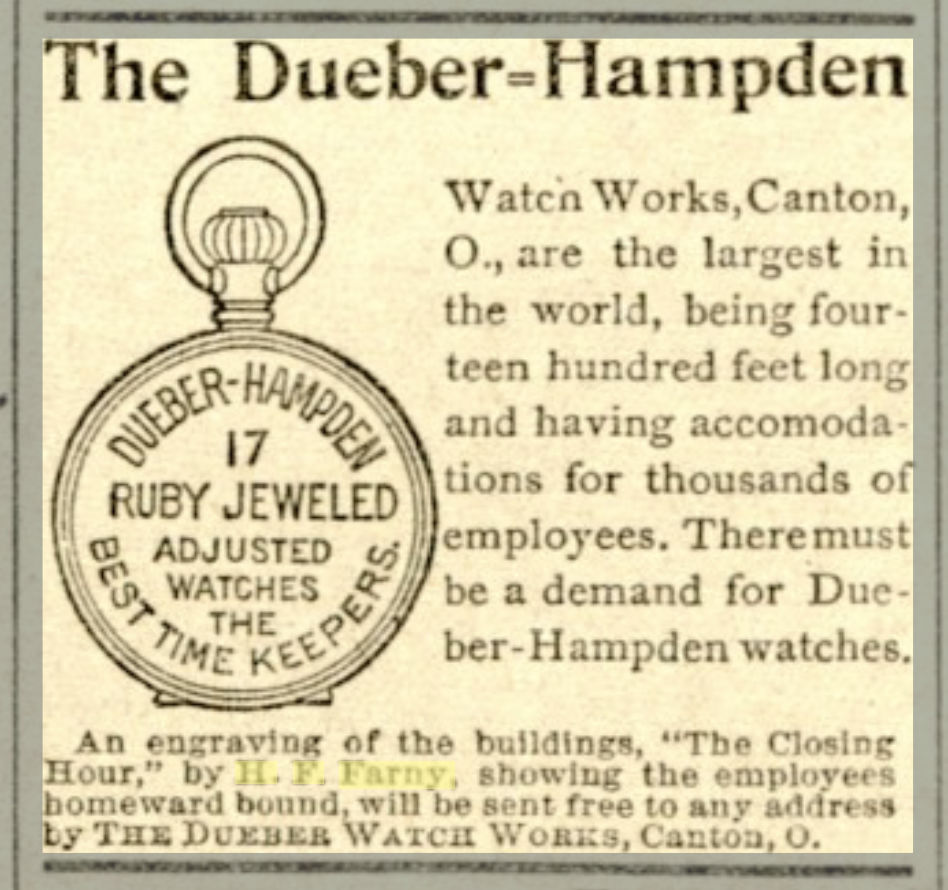
Though I’ve been unable to find a copy of Farny’s illustration, I did locate a description of it published in the February 26, 1890, issue of the Cincinnati Enquirer, page 5, column 6:
THE CLOSING HOUR: An Artistic Sketch by Farny on Exhibition.
A Simple Subject Serves as the scheme For a Striking Picture
There is on Exhibition in Robert Clarke & Co’s windows a striking sketch in black and white by Farny, which bears the title, “The Closing Hour,” that is attracting more than ordinary attention. Its subject is at once simple and novel, and the simplicity seems to be its chief charm. The scene is laid at the doors of an immense factory, whose throng of busy workers is being discharged through the great entrance at evening.
The Soft Semi-tone of Twilight Pervades the entire picture, light and shadow being insensibly blended. In the foreground is a bit winding creek, whose shallow waters reflect the light of the sinking sun just passing below a hidden horizon. In opposition to this high light is th shadow of a clump of willows, the contrast being admirable. Across the creek, toward the observer, springs a bridge, on which appear several groups of workers hurrying homeward. Two elderly men, wrapt in conversation: a group of young, bright-faced, laughing girls, and a solitary, serious-visaged lad stand out more prominently than the others. High up on an artificial bank arises the huge, shadowy form of the gigantic bee-hive, the outlines thrown into bold relief by the rays of the setting sun behind it.
At either side the long building stretching away in the perspective, gradually merges into the gray of the fading twilight, the details being faint and obscure. The idea of the artist—to fix the eye upon the mass of humanity pouring forth into the rest of the details only strengthening and heightening the central scheme. It is a good specimen of the monochrome work for which Mr. Farny is justly celebrated. The picture is the property of the Dueber-Hampden Watch Company of Canton, Ohio, for who it was painted. The sketch, in fact, was made by the artist at the factory of the watch company at the time that its brightly suggestive title indicates.