In March 1893 The Women’s Columbia Exhibition Association (WCEA) held a fundraiser to earn money for their upcoming 1893 Chicago World’s Fair Exhibit. The asked Henry Farny to arrange a show based on his paintings and Indian artifacts. It would constitute his very first solo show. A long description appeared in the March 16, 1893, Cincinnati Tribune. Here is most of the text:
Of course, the center of attraction was the exhibit of the sixty pictures by Mr. H. F. Farny, and a verity interesting show it made. Considering the difficulties of hanging so many pictures in two ordinary rooms, with a maximum of windows and doors and a minimum of wall space and light, the successful effect was something extraordinary.
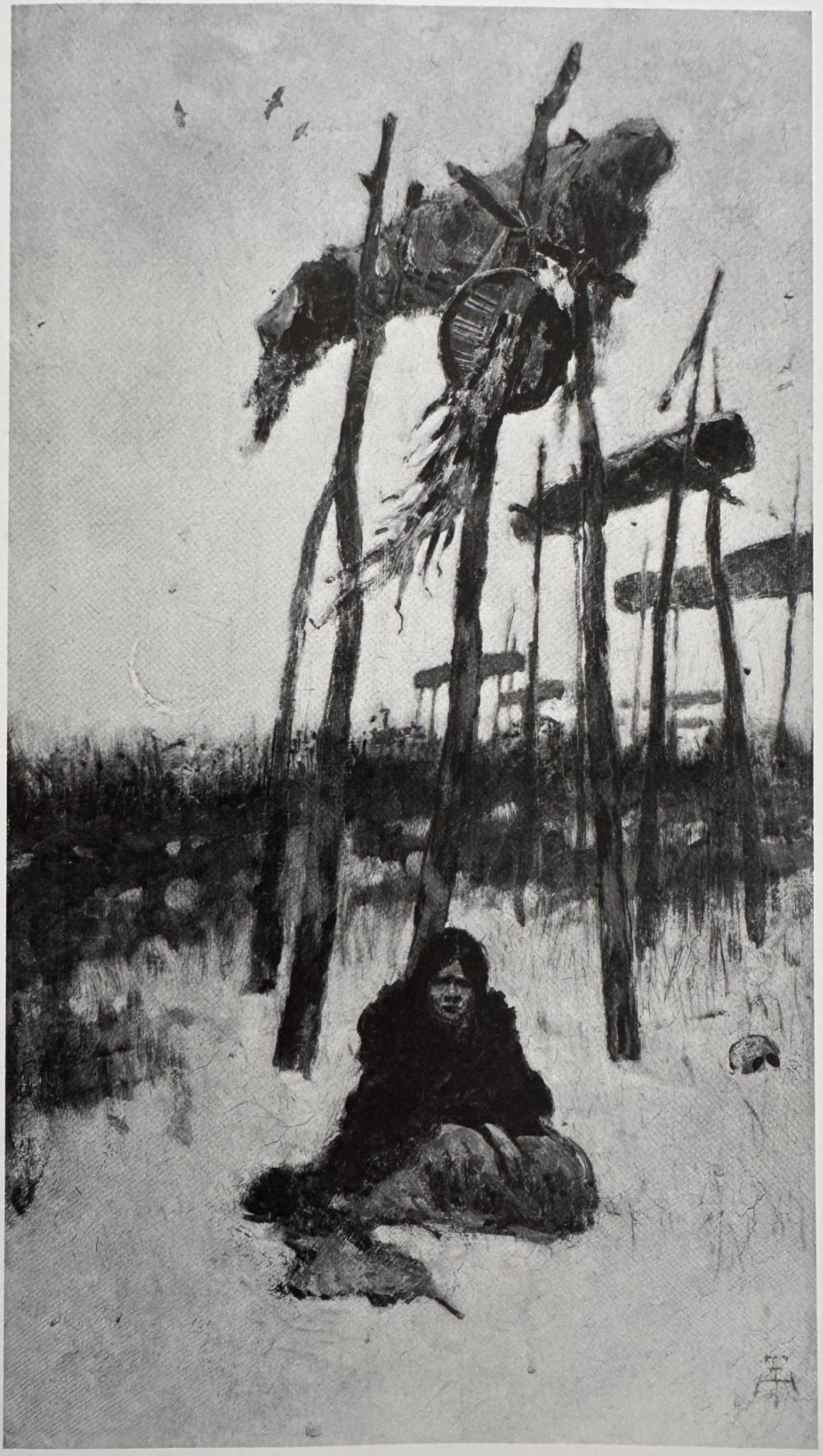
The artistic arrangement of Indian robes, implements generously loaned, loaned by Mr. Farny, Frank Goodhew and Mr. Wells, added to the ensemble. All of the more important of the artist’s pictures were there, except Mr. Fleischman’s “Last Vigil,” which, if not the best painted of Mr. Farny’s works, shows the most feeling and sentiment of any. Unfortunately Mr. Fleischman was South, or the picture would not be absent. Indeed, it is on record that not one picture was refused the Iadies without a good reason, even Mr. Althman, who owns “The Captive,” writing from New York that the ladies were welcome to the use of his picture, an offer that, how-ever, came too late.
If this collection of paintings, nearly all relating to the American Indian, could be seen in New York City, we predict that a sensation would be the result. Remington’s Indian pictures were much talked about, but as a painter of pictures, such as one wants to hang on the wall, Mr. Farny is superior.
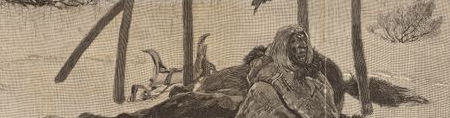
One or two of the older works will bear mention first, and are to be respected for their age. No. 59 is a rough sketch made at a sketch club. The subject, “Death,” [aka “Indian Graves”] was afterward elaborated into Mr. Fleischman’s picture [“Last Vigil”]. This sketch is now owned by Mr. Alexander Hill. An oil owned by Mrs. Laman is also one of the early efforts. “Solitude,” shows the blackness of night.
No. 2, which is prized by the artist’s sister, was the first result of Mr. Farny’s brush, in 1870, after his return from Europe. The Subject, “Capri,” is well treated, and he is not ashamed of it, by any means [“1872 Monte Castello, in the Island of Capri”].
No. 19, owned by Mr. Charles Taft, is his second water color. Mr. Farny returned from Europe with the usual antipathy to water which pertains to all Munich students, and his early efforts were confined to oil. Mr. Taft’s picture, “The Hill Behind the School House,” carries us back to our boyhood, and the light in the windows of the old building is well portrayed. Shortly after the return of the artist from Europe, and before he “struck his gait” to success, Van Antwerp, Bragg & Co. gave him all he could do in illustrating school books. This led him into more serious illustrating, and the Harpers employed him to paint in gouache some large, double-page illustrations, which, after engraving, were returned to him, and a few important ones have found their way to these walls.
“The Snake Dance” and “The Tablet Dance” do not feel the lack of color to make them interesting; neither do his drawings of “Silence” and “Sorrel Horse,” and numerous other black-and-whites.
The “Silence” referred to was the process drawing for Mr. Van Antwerp’s large painting, which was really one of his first pictures that made a palpable hit, and the artist received what was full value for it then, but would be about one-quarter the price of a picture of similar size nowadays.
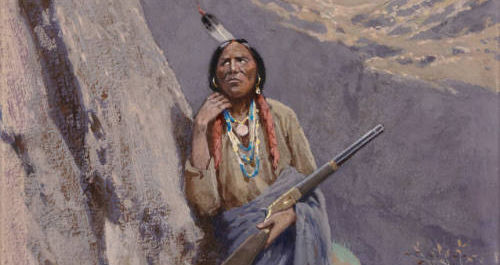
In some respects the best picture in the room is Mr. Addy’s large oil of the Indian Camp [probably 1890’s “Indian Encampment”] although Mr. Proctor’s “Camp of the Hostiles” is preferred by many. The quality of the blue ether expressed in the fissures of the rocks in the later picture is rarely equaled in effect. While the general rich decorative effects in color of the picture is the marked merit. The oil picture loaned by Mrs, Billing, “Renegade Apaches,” is historic in interest, the most of the figures being portraits of Geronimo and his band. Colonel Latham Anderson can tell some interesting stories of this raid, for he was in service at that time, and was pretty nearly cornered once or twice by the wily brave. It is well to note the contrast between the daylight effect of the sun-kissed mountain at the top distance and the night effect of the fire-lighted canon in the lower distance and foreground. This is a remarkably successful attempt to paint a difficult subject.
Mr. Howard Hinkles’ “Alarm,” No. 3, [originally “Danger”] is well hung with its decorative label, for it took a salon a few years since. It contains one of the largest figures Mr. Farny has yet successfully painted. Every artist, however successful, has his limitations, and we are of the opinion that Mr. Farny’s paintings of moderate size are his best.
A little picture hung near “The Alarm,” No. 7, named “And Once on a Time There Were Buffalos,” is owned by Mr. Frank Duhme, and is a gem. The effect of light and is shade simply defies description, as does a scene, all snow, No. 14, on the next wall.
This is probably one of the hardest effects Mr. Farny has painted. It is absolutely true. Some of his pictures tell a story, as, for instance, Mr. Althman’s “Captive,” in New York; “No. 22,” “The Long Shot,” and “’Got Him!’” the latter showing a Chiricahua Apache tumbling from his pony, shot by one of a number of “Regulars” chasing in the middle distance. We must not forget “The Mountain Trail,” which arrived just in time for this exhibit after is exhibition at the Water Color Society’s show in New York. Mr.Taft’s
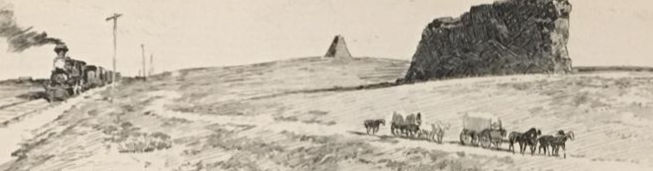
“Apaches Are Out’ is something like this picture. That Mr. Farny can depict character is shown in numberless small single figures, filling in small spaces on the walls, such as the “Border Dandy” and one or two lovers playing Indian flutes. While the public give more financial encouragement to his warwhoop Indians, his peaceful Iroquois and Zunis are even more picturesque. Their adobe architecture against the sky, the quaint ladders and pottery, while the figures themselves with their picturesque blankets are quite as catchy as their warlike brethren.
As for the squaws, the Zunis are attractive and the others are not. Note the young maiden in “The Zuni Courtship,” a small, but beautiful picture loaned by Mrs. Barton, and the figures in No. 25, “Drawing Water at Laguna,” which, by the way, is the only picture in the collection that can be purchased [It stayed within the family].
An architectural picture, No. 18, shows Zuni adobes to the best advantage, while No. 15 is, perhaps, the best of its class, depicting a rare shadow effect in the foreground.
The picture which is the most tender in color in the whole collection is Mr. Erkenbrecker’s “When the Grass Grows.“