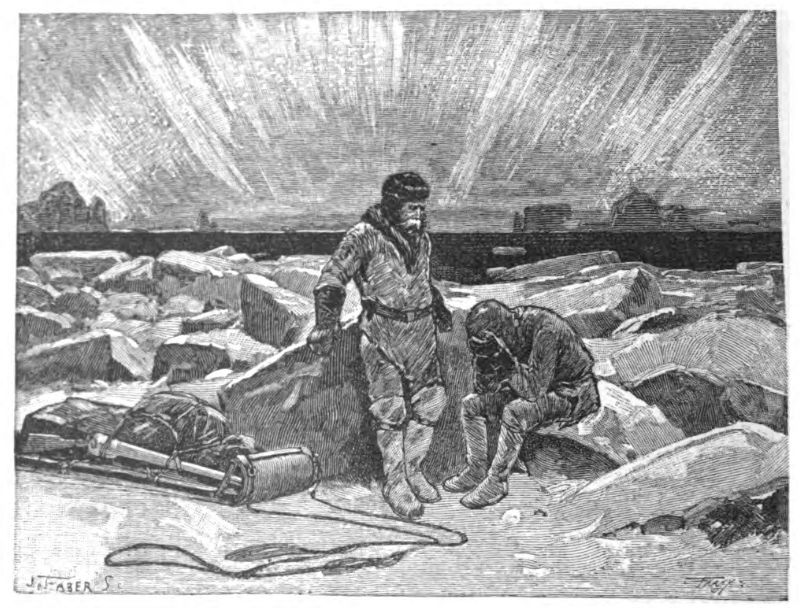
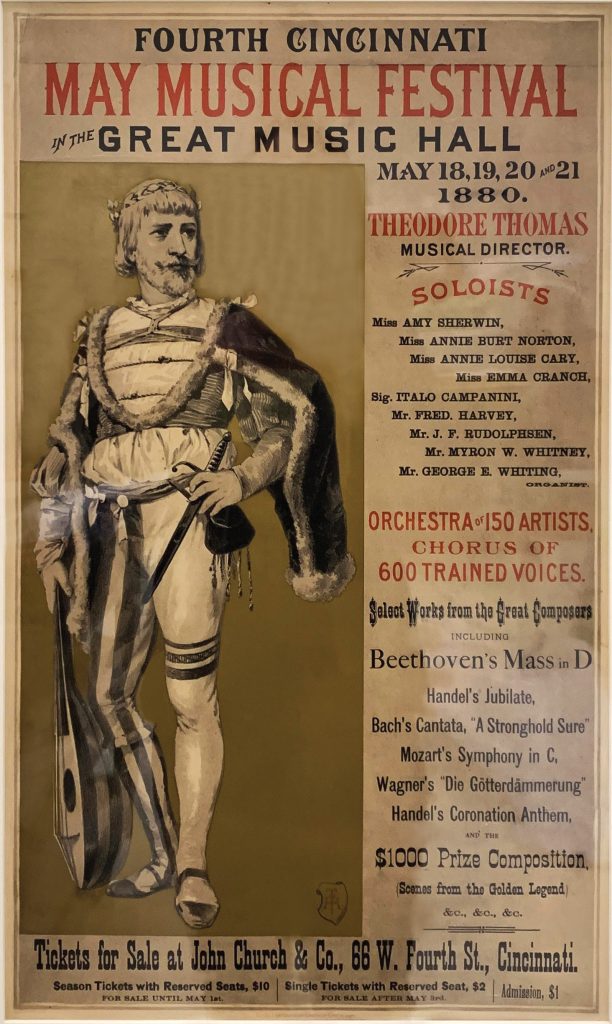
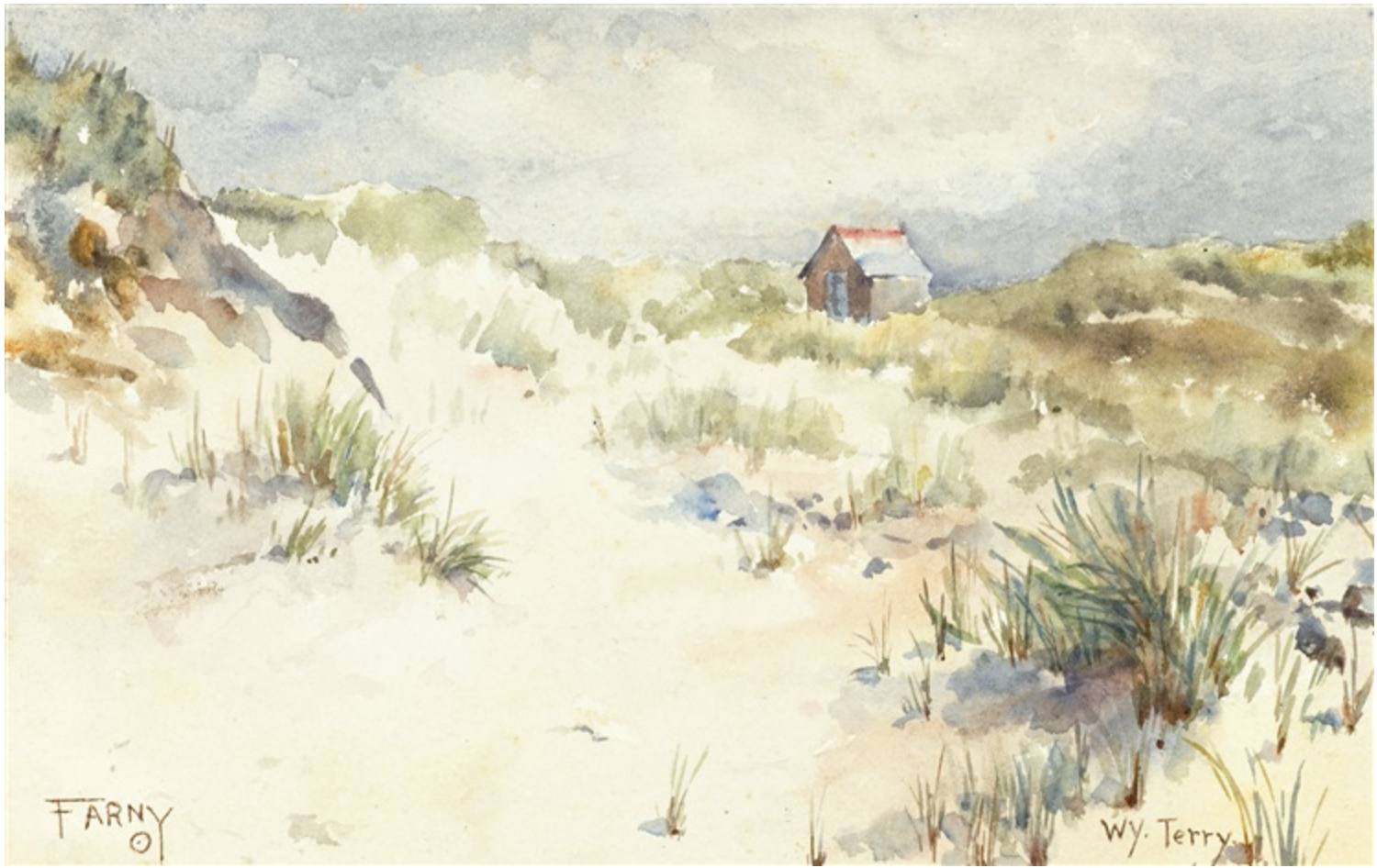
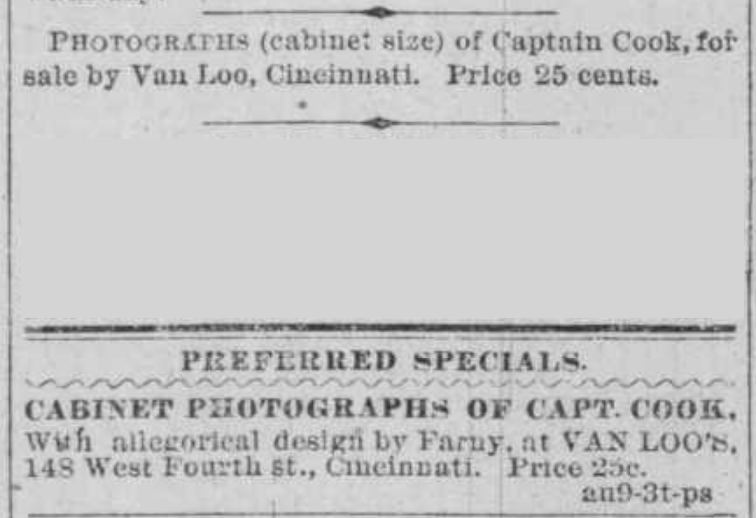
Two 1881 ads appear in the Cincinnati Commercial nearly atop one another offering Capt. Cook Cabinet photos for sale. The lower of the two notes added that the allegorical designs accompanying the images were done by Farny. The photos were being sold out of Van Loo’s studio, though it’s unclear whether these were Farny’s work consigned to sell at Van Loo’s or if they were owned by Van Loo.
I have been unable to find any examples of these photographs.
LEON VAN LOO – Biography
Leon Van Loo was long associated with the Cincinnati art scene and he and Farny were long time friends. Often mistaken as being born in Belgium, and in one case Genoa, Italy, of Belgium parents, on his 1889 passport Van Loo wrote that he was born in St. Georges, France, on August 19, 1841. Whether technically French or not, Van Loo appears to have grown up and always treasured Belgium.
As a youth living in Belgium, Leon Van Loo struck up an acquaintance with Charles Waldack, who taught him how to daguerreotype. As a thanks for helping his son, Van Loo’s father paid for Waldack’s emigration to the US, arriving in New York in 1855. In 1857, Charles published a “Treatise on Photography on Collodion”, while also opening up a studio at 31 1/2 West Third Street.
It’s likely that Waldack’s experience in Cincinnati helped induce Leon Van Loo, now ages seventeen, to leave Belgium and emigrate to Cincinnati at the end of 1858. There in Waldack’s studio, Van Loo continued being mentored on photography by Waldack.
In 1862, Waldack returned to Ghent for a year, turning over the studio to Van Loo. At some juncture, perhaps on Waldack’s return in 1863, Van Loo opened his own studio at 148 West Fourth Street. That same year Van Loo became a naturalized citizen.
Following the civil war, Van Loo invested in southern cotton and reportedly did well, eventually reporting the value of his estate on the 1870 census at $15,000. With his new found wealth, Van Loo began to travel extensively. As early as autumn of 1866, Van Loo and Fresco painter Signor F. Pedrettti organized a European trip that would take them over Italy, Germany, France, And Spain, before returning to the 1867 Paris Exposition. Along the way, Van Loo would begin his life long love of art collecting.
At some juncture following the Civil War, Leon Van Loo would likely have become aware of Henry Farny. Van Loo and T. Buchanan Read were good friends, and both members of the first Cincinnati Sketch Club (see tangent story about Van Loo and Read below). Given the close relationship between Read and Van Loo, and given Farny’s decision to defend Read at the 1866 Opera House and Art Museum build meeting, it’s entirely possible that Read could have introduced Farny to Van Loo prior to Farny leaving for Europe in 1867.
One could imagine that Van Loo and Farny could have hit it off, especially given that both men were fluent in multiple languages. In later years, when comparing Farny and Van Loo, one reporter noted in 1904 that when, like Farny, when Van Loo was in a mood to talk, it was a pleasure listening to him.
Farny, following his return from Europe spent time working out of Van Loo’s studio. Newspaper reports have Farny there by 1873. They both would have shared excitement over traveling to Vienna for the World’s Fair as well, since both had exhibits, with Farny showing off his Pork picture and Van Loo showing off his photography.
In 1875, Van Loo introduced a new kind of photography he called “ideal.” Photographs using this technique are printed on zinc oxide applied to blackened sheet-iron and present a pearly, transparent surface. Yet, despite his passion for photography, he tried hard to become an accomplished painter, especially a portrait artist.
Over the 1880s Van Loo’s name pops up frequently in article related to art in Cincinnati. He was a charter member of the Cincinnati Art Club in 1890 and became its president between 1894-1896 and 1903-1904.
On his death in January 10, 1907, Van Loo put aside $250 for a banquet where he would host his 150 friends. His goal was to return and visit his friends from the spiritual world. An empty chair was left for him, but while his friends ate well that evening, they saw no sign of him.
Van Loo’s story of how Read came to write his famous Sheridan’s Ride poem:
Van Loo claimes he was there with Read in November of 1864 the exact moment when Read, James E. Murdock and Van Loo were walking down town when they came upon Rickey & Carroll’s book store. There in the window was the latest Harper’s Weekly, November 05, 1864, which had just come out, with “a spirited title page picture of Sheridan’s ride down to Winchester–Sheridan on his great black horse”. With his right hand, Murdock dramatically gave Read’s shoulder a wack and said “Buck! (he always called him Buck)–there’s food for a poem!”
Van Loo promptly bought an issue, then the group went to supper at Garretts, where they enjoyed their evening. Van Loo left his friends at 11pm, also leaving behind the magazine. The next morning, Read, accompanied with a cup of strong coffee, promptly locked himself away in his front room and by 11am he had completed his poem. That the story had deviated in re-tellings, especially when Murdock got no credit for the inspiration, irked Van Loo for years.