On April 30, 1884, The Cincinnati Commercial Gazette commented on Farny’s newest Indian work, noting that Farny was using a ‘higher key’ than normal, meaning he may have been experimenting with shedding the darker colors of his Munich tendencies towards a brighter image. It seems possible that this was an early look at what we now call The Captive:

By January 9, 1885, Farny’s newest painting was near complete, though no name was yet mentioned, and the Cincinnati Commercial Gazette reporter was confident this newest creation would add to Farny’s reputation. The article includes a long description:
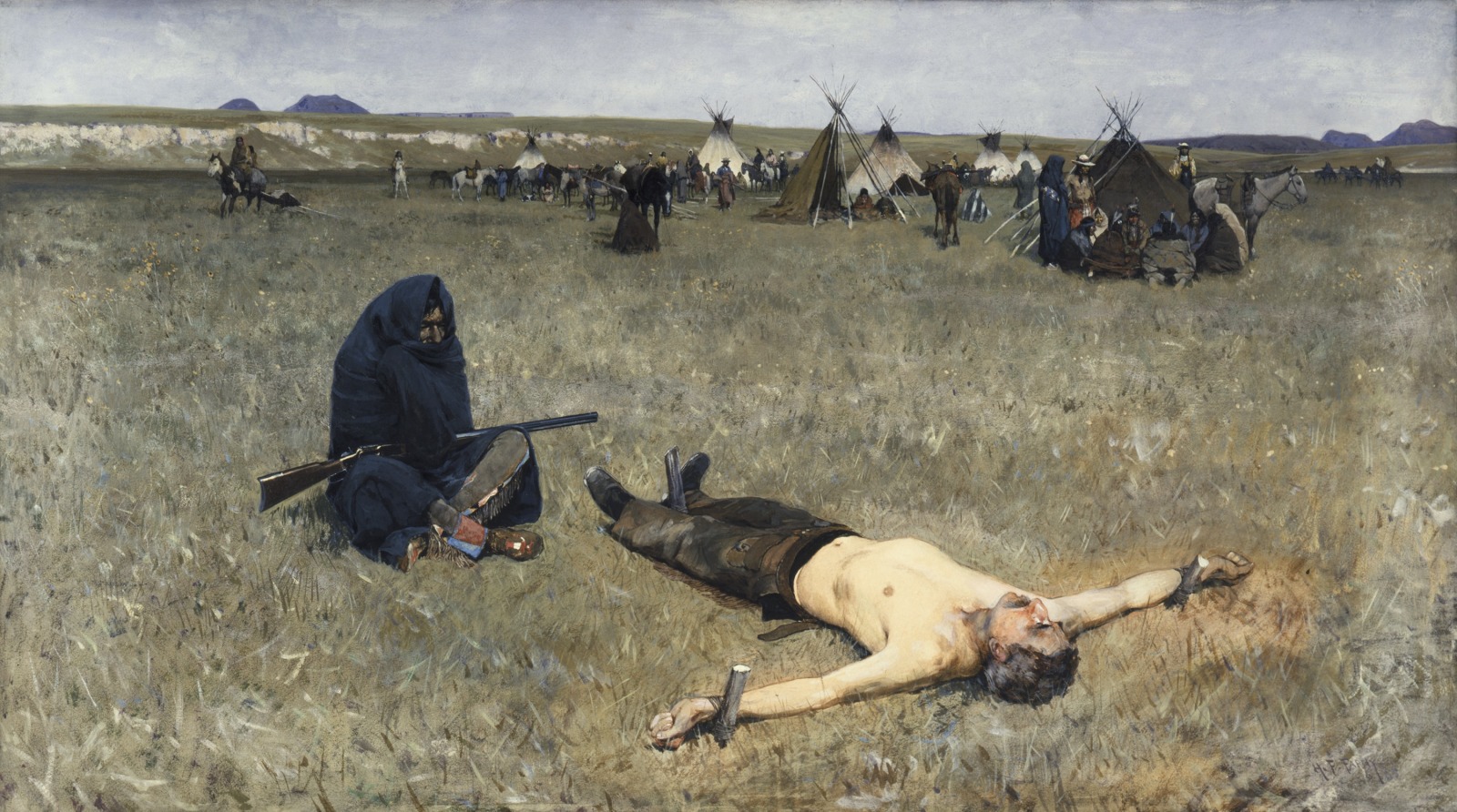
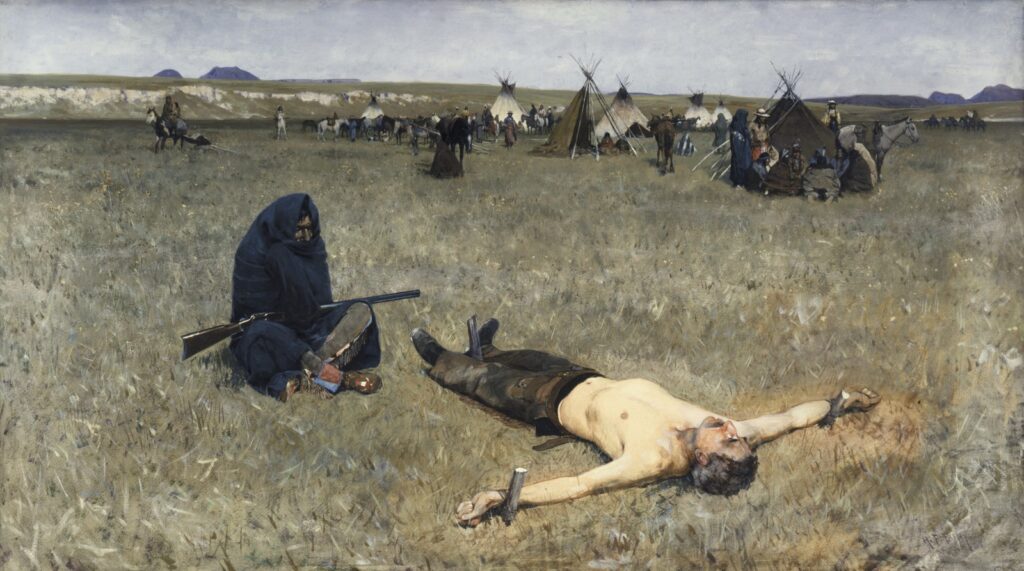
-Mr. H. F. Farny has now upon his easel in an advanced state of composition what promises to be a most notable addition to his gallery of pictures depicting scenes from the lives of the Indians of the Far West. The picture represents a tepee village in the background, with the Indians taking down and packing the tepees preparatory to migrating.
In the extreme foreground is a white captive stretched upon his back upon the ground, his feet and hands stretched apart and bound to stakes. Near him sits a guard upon his haunches, a grim and ugly figure, his rifle across his knees, and his blanket drawn across the lower part of his face, his sinister gaze fixed upon the victim who lies, naked to the waist, his face upturned to the pitiless sun awaiting his doom. That is being decided by a group of warriors who are squatted in a ring further back, near the pony of the captured cowboy or scout, for such the captive appears to be. The whole scene is wonderfully vigorous, picturesque and striking, and the appeal to human emotion and sympathy is very strong in the prostrate figure of the prisoner, who awaits the decision, which is merely as to the kind of torture that shall be applied.
The treatment of the atmosphere is superb. The tone of the picture is high, according with the clear, pure and glaring light of the mid-day in the table lands. This feature is strongly treated, and the dreariness of the landscape in the high volcanic regions, with the alkali soil, scrubby growth of grease root and sage brush, and striking contrasts between the pronounced colors in deep. rich blue of the far-away buttes, and the dull, Oriental tints of the foreground given with a master hand. The very spirit of the plains is suggested–the savage loneliness, the vast perspective, the very silence is depicted, all tending to make more terribly suggestive the fate of the poor vietim through which human interest is introduced.
The wonderful purity and rarity of the atmosphere is shown in the preraphaelite treatment of details, even so far back as the middle ground, where, in our atmosphere, all sense of detail would be lost and little beyond outline treated.
In the East, Mr. Farny is alrendy recognized as the master in this field of painting, and his work, taken from life and nature and his own experience among the Indians, is making a sensation in the manner of depicting scenes in that department of artistic work.
Despite the glowing review, Farny seems to have kept the finished painting until he entered it into a November 1885 American Water Color exhibit in New York, titling it “The Prisoner”. According to a 1902 article, the reason Farny entered it in the exhibition was due to a request by E. H. Barton, the local gallery owner, asking Farny if he had something to enter.
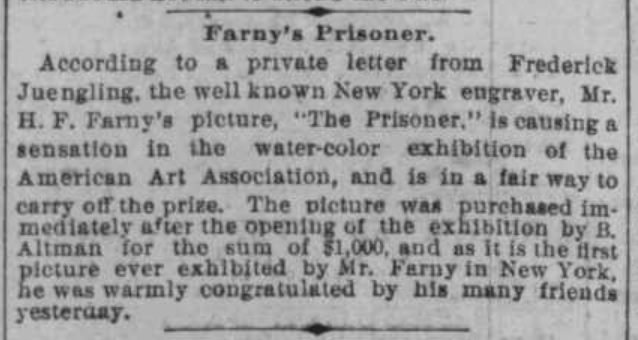
Barton apparently forwarded the finished painting to the exhibition and, according to a November 5th article in the Cincinnati Commercial Gazette, it caused a stir:
Several days later, the New York Sun gave a glowing review of the work of the subject matter, though noticed some flaws in execution:
In the water color exhibition there are some charming little passages of Iandscape and one vigorously treated and well-handled subject, original and American, by Mr. H. F. Farny of Cincinnati. This is an artist of implacable unconventionality, and we trust that this is only the first of many serious and significant pictures that we shall have from him.
The subject is from the northwest frontier, betrays careful study and intelligent observation, and, for all that it contains errors of drawing and weakness of anatomy. Implies the hand and head of a very considerable artist. We have not seen any subject before, chosen from among the North American Indians, in which a certain sickly sentimentality, Cooper-Iike romanticism, picture-making trick, or similar unwholesome untruth did not rob it of all real value and significance. Mr. Farny is a man of facts and execution.
The New-York Tribune was more savage in it’s review, especially when it came to the use of the opaque color treatment:
Among the water colors at the American Art Galleries, called with a touch of satire a *prize exhibition,” studies of the figure play a generally unimportant part. There are exceptions in the work of Miss Greatorex, to whose extraordinarily mature child, planted in the exact middle of the plcture, we have already alluded, and to Mr. Farny’s Indian subject.
The latter shows a not uncommon misapplication of him medium. He has used opaque color throughout, giving the effect of a study in oils, and thus neglecting certain peculiar advantages of transparency and atmospheric vividness inherent in pure water colors. It would have been more workman-like to use transparent color and the paper itself until the body color seemed absolutely necessary. One cannot help noting that the heavily loaded paint is already cracking, an unfavorable omen for the picture’s future.
Nevertheless, Mr. Farny’s study of the half nude agonized captive, lashed down and watched by an Indian, whose striking figure expresses a world of quiet devilish malignancy, is one which is sure to attract a large amount of popular attention. All is characteristic, from the tepees in the background to the manner in which the captive is “staked out.” The artist deserves credit for his attempt to utilize Western material, and if his subject had more to do with art, it could be warmly praised without reference to technical shortcomings.
If Mr. Farny had chosen to paint a pinioned murderer on his way to the gallows in the Tombs court-yard, the inappropriateness of his picture, to say the least, in an exhibition supposed to be composed of “works of art,” would have been at once apparent. But the figure of his captive is far more ghastly than the Tombs subject, and in point of suggestiveness, the legal execution is a cheerful object for mental contemplation by the side of the unutterable mutilations and hideous tortures inflicted upon the captive of the Indian.
Such a subject as this appeals to a morbid taste. Nevertheless the picture has much sought for element of novelty, which is set forth with some real ability. The prizes are to be awarded by popular vote, and the form of realism is likely to receive a prize.
The New-York Tribune critic was correct. The popular vote went Farny’s way as he fetched one of the four top prices of $250 (Per Harper’s, column 3, midway). Add to that the sale of the painting for $1000 to B. Altman and his year-plus long effort paid off well. (Note, the low prize amount reported was $250 by Harpers, other reports suggested the prize was higher — I am going with Harper’s number).
The success of Farny at the exhibit produced immediate results, with Farny receiving telegrams probing what other paintings he had for sale. But, according to the Cincinnati Commercial Gazette, Farny didn’t have much ready to sell, though he had beginnings of a painting he was calling Danger. This shouldn’t be a surprise, given Farny had, for years, been focusing on illustrations for books and magazines, as they had made him a living.
Later, in the February 13, 1886, issue of Harper’s Weekly, an image of Farny’s The Prisoner, and labeled as such, was displayed on page 109.
One interesting aspect is that though Farny originally titled the painting The Prisoner, the press referred to the subject matter as the captive. Perhaps that is why, by 1902, the name of the painting had evolved into The Captive. That year the painting was put up for sale by B. Altman, but it did not sell. Finally, in early 1903, then Mayor Julius Fleischman purchased the painting for $1500. Eventually (1927?), his kids donated it to the Cincinnati Art Museum in his memory. Fleichman owned at least two other Farny paintings, The Last Vigil (1881) and Yarns of a Summer Day (1894), both of which he lent to the 1915 Farny exhibition.
On a final note, The Cincinnati Commercial Gazette noted soon after his win:
Farny, upon being congratulated by a gentleman upon his success, in so deservedly winning the prize for his water-color in New York, immediately replied, with great empressment and ready wit: “I believe it is true, although not authenticated directly, but,” he added, “I’m awfully afraid the fellow will sober up before he writes the check.”