Farny unveiled his first Indian-themed work titled Indian Graves (by a newspaper) in October of 1877. The painting followed a trip west several months earlier. Despite what many biographies claim, that his first trip was in 1878 (A Missouri canoe trip that didn’t happen until later) or in 1881 (a year he took may have taken two trips west), there is ample evidence his initial journey west was in 1877 and his initial encounter with Plains Indians in their regional areas happened with this trip. Below is an account of how that first western trip came to be, followed by information on the artwork related to 1877’s Indian Graves and its subsequent iterations.
Going to Europe in 1875: We start with a trip to Europe, because it is in Europe that Farny finds a reason to go West.
On August 05, 1875, the Cincinnati Commercial announced that Henry Farny, along with painter Frank Duveneck, painter John H. Twachtman, sculptor Frank Dengler were leaving for Munich, Germany, to study art. Once they got to New York, they planned to travel to Europe on the steamer “Rhine”, then spend a couple of years in Germany.
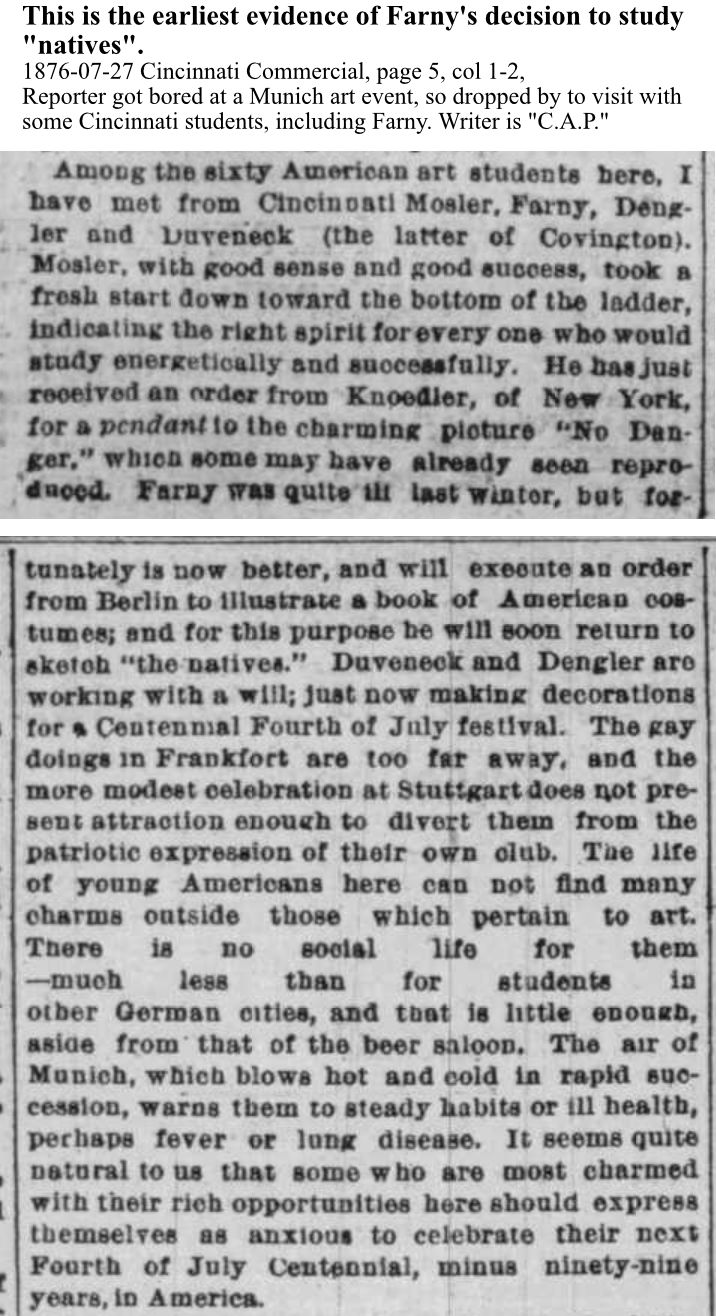
A year later, in July 27, 1876, we learn from a reporter in Germany that Farny spent the winter very sick. By summer his health had returned. We also learn that Farny secured a German contract to illustrate American Costumes and that he planned to return the the United States so he could sketch “the natives”.
1876 Trip back to the states: Farny left Le Havre, France, for New York in late July of 1876. He boarded the ship “dead-broke”, dragging his own trunk, but over the next week as the St. Germain plied the waters westward, it’s dual stacks puffing away, Farny began drawing and charming his fellow steerage passengers, launching an adventure worthy of the Titanic’s Jack Dawson.
According to an eye witness, who several years later relayed the story to a Cincinnati Times-Star reporter, Farny began to make comical sketches of fellow steerage passengers. The ship’s crew took notice of his drawings and asked him to draw pictures of them for their girls, for which he naturally charged a nominal fee. Eventually, even the ship’s Captain was charmed, offering Farny privilege of the entire ship. With run of the vessel, the more well-to-do cabin passengers became acquainted with Farny and his skills. So popular he became that John William Mackey, one of the richest Americans, thanks to his stake in the Comstock Lode, befriended Farny and invited him to occupy a part of his state-room.
Farny declined the invitation, because “he had become so popular in the steerage and among the sailers he preferred to remain in his own quarters, and I never saw a man appear more thoroughly to enjoy a trip over than did Farny”. And, even though he remained in steerage, the steward sent him and his new-found-friends the best food.
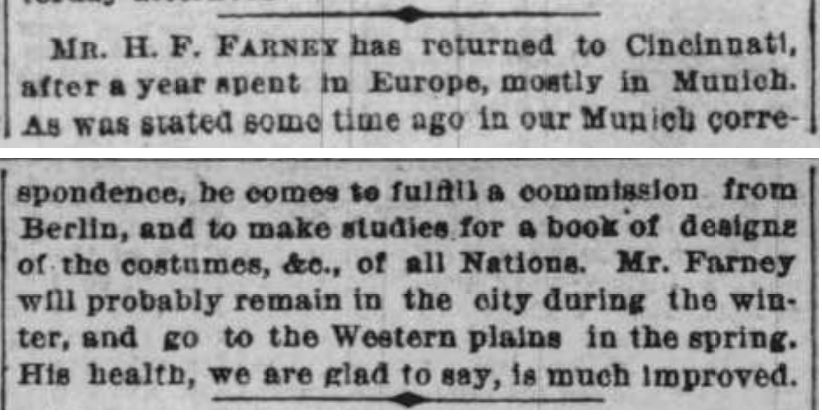
On August 4, 1876, Farny arrived in New York and a few days later, he was back in Cincinnati. The following week, August 14, Farny confirmed with the Cincinnati Commercial that he would be going west in 1877:
The spring of 1877 provided no updates on any trip west for Farny. The fact that General Crook was busy with the Sioux may have delayed Farny’s excursion.
However on May 26, 1877, Crook finally came to an understanding with most of the Sioux leaders at Fort Robinson, located in Northeast Nebraska, which made the area at least a little more peaceful.
The 1877 Trip: A month later, on June 29th, 1877, The Cincinnati Enquirer reported that Farny would be heading west to “Fort Dodsworth”, Colorado, the guest of General Crook. I’ve had no luck locating “Fort Dodsworth” in any histories nor on amu map, so in seems either Farny was wrong about the location or the reporter made an error. But, as we’ll see, he did go west.
So if not Fort “Dodsworth”, where did he go? Wherever he went, the location was home to Sioux tribes, and Fort Robinson fit that bill, but so did a place in the Dakotas where he later went. However, it’s entirely plausible that Farny ended up at Fort Robinson for a couple reasons. One, Fort Robinson was a place Crook was at just a month earlier, so I could imagine, if truly a guest of Crook, that Crook might have though that a relatively safe place to send Farny.
Two, according to a July 13 article in the Omaha Daily Republican (which I have not read just yet, as it is not online), the story supposedly describes a big rise in visitors going to Fort Robinson that summer at about the time Farny would have visited there.
The evidence of where he went obviously remains thin, but my hope is the Omaha article names him, as the article apparently names a number of the visitors that summer.
Three months later, following his trip West, an October 14 article in The Cincinnati Commercial describes a new painting from Farny based on his recent experience:
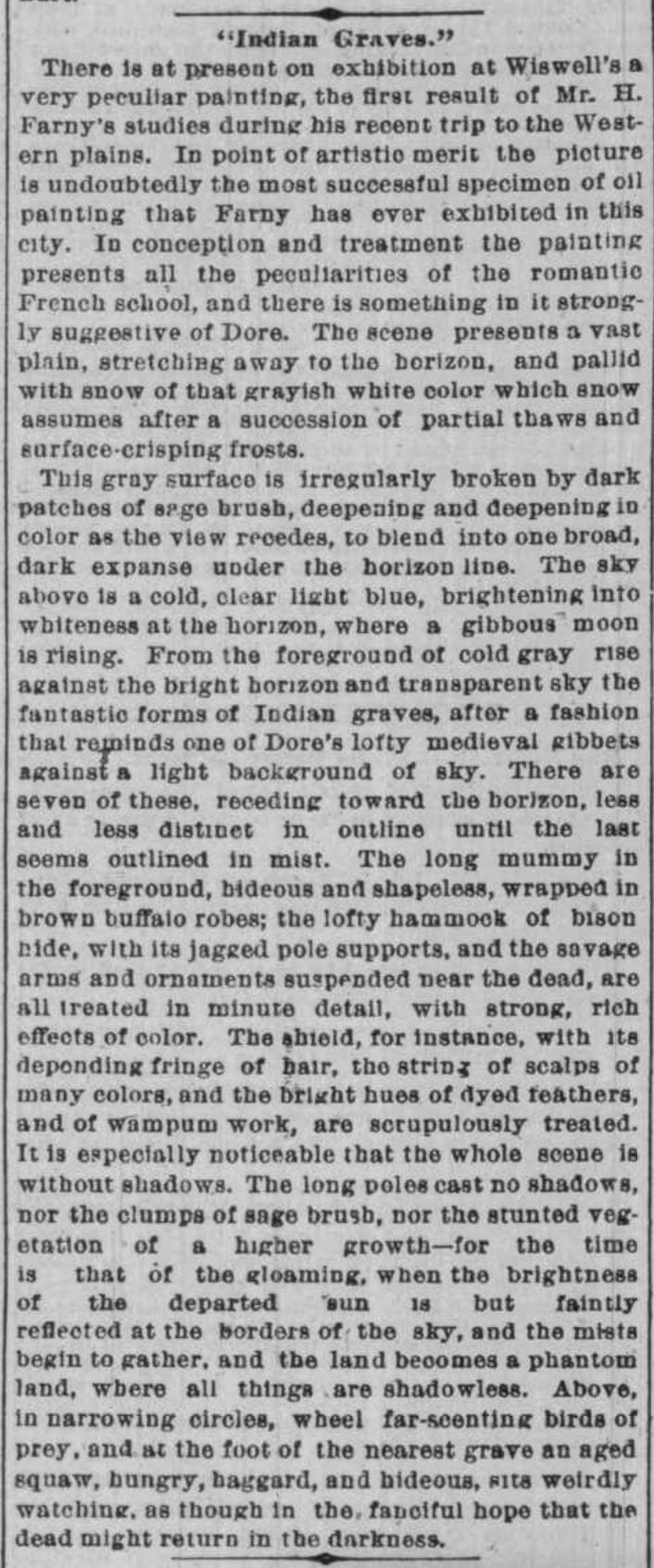
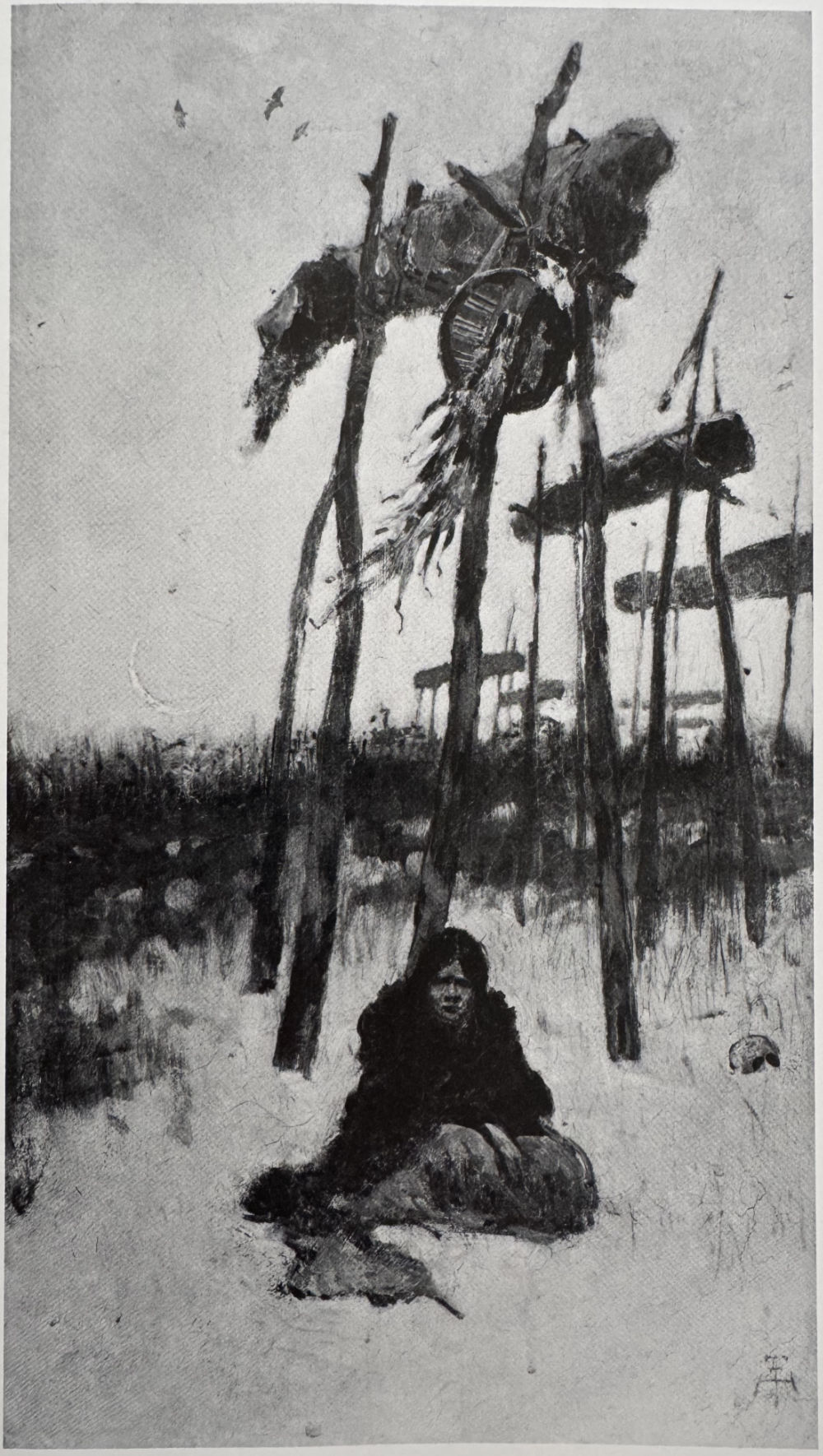
The article also discusses Farny’s newest painting in depth, a result of his recent trip west. The article is titled Indian Graves, but it’s not clear if this was the actual title of the painting or not (it was later called “Death” at the 1893 Farny exhibit). What we learn in the article is that this painting features at least seven “graves” or pyres, the moon on the horizon and distant birds of prey. We also learn that Farny plans to make another painting from this one. It sounds more “study-like” than finished product. In fact, it may have been more a whim due to the Sketch Club’s theme that month, which was “death” for which this was supposedly created.
The image that best fits that description can be seen on page 43 of Denny Carter’s book on Henry Farny. Titled The Vigil in her book, the work contains Farny’s “symbol” signature, making it likely it was painted pre-1881. Pictured are seven pyres, birds of prey above, the moon, along with other elements from the article above. I believe this is the 1877 piece labeled Indian Graves by The Cincinnati Commercial:
The Last Vigil and End of the Race: Fast forward several years later to January 1881. The Cincinnati Enquirer reported that Henry Farny’s newest painting, The Last Vigil, will make him famous. The painting was originally owned by Charles Fleishman, but was last documented as being owned by Mrs. George A. Rentschler, New York, New York.
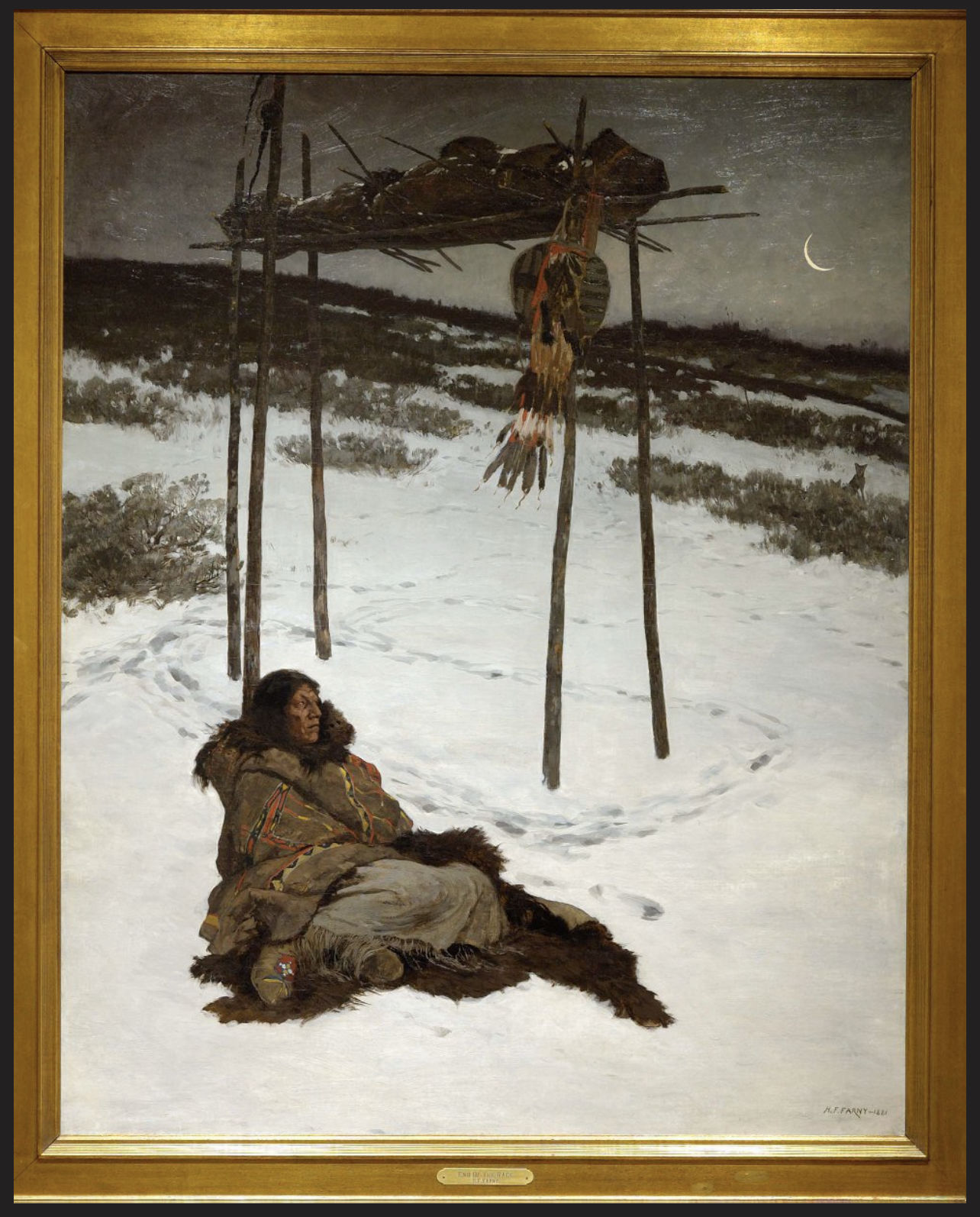
Pictured below is an image from the Frick Museum’s Digital Art Library that claims it is The Last Vigil … I am wondering it this is Farny’s 1881 The Last Vigil OR ACTUALLY his 1881 End of a Race painting?
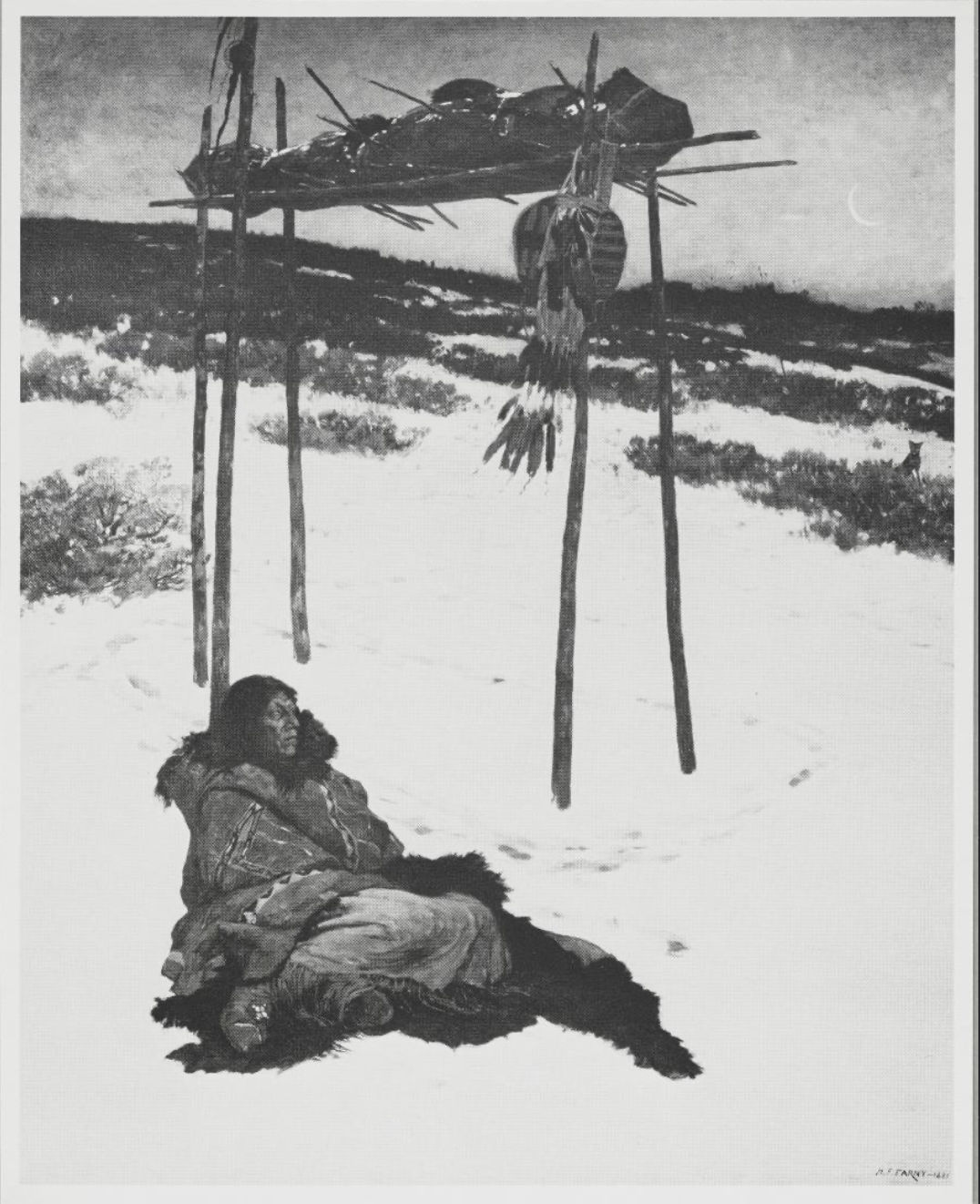
On February 02, 1881, Farny revealed his latest painting, End of a Race, a work that looks a lot like The Last Vigil. In fact it looks like an exact copy, which made me wonder if the Frick image above was mis-labeled. See more below. The End of the Race is currently in Wyoming:
In June of 1881, the painting titled The Last Vigil was sent to Paris for exhibit, but sadly didn’t make it in time for the exhibition.
In 1882, Farny again entered The Last Vigil into the Cincinnati Industrial Exposition, along with a watercolor Blackfoot Indian, which it appears Farny still owned, The Camp of the Uncupapas, owned by James McDonald, Solitude, owned by L. Van Antwerp (like of Van Antwerp publishing), and a punch bowl given to Farny by the Zuni Indians, as added evidence that Farny visited the Zuni Indians.
While sketches of the Blackfoot Indian and the Camp of the Uncupapas, which was the name of Sitting Bull’s band, were not included in the 1882 illustrated catalog, Farny’s The Last Vigil was depicted.
What’s curious is that even the rough sketch show below, done for the catalog, suggests The Last Vigil had enough differences to differentiate it from The End of the Race. My guess is that if the original The Last Vigil surfaces, it will look closer to the catalog image below than The End of the Race above.
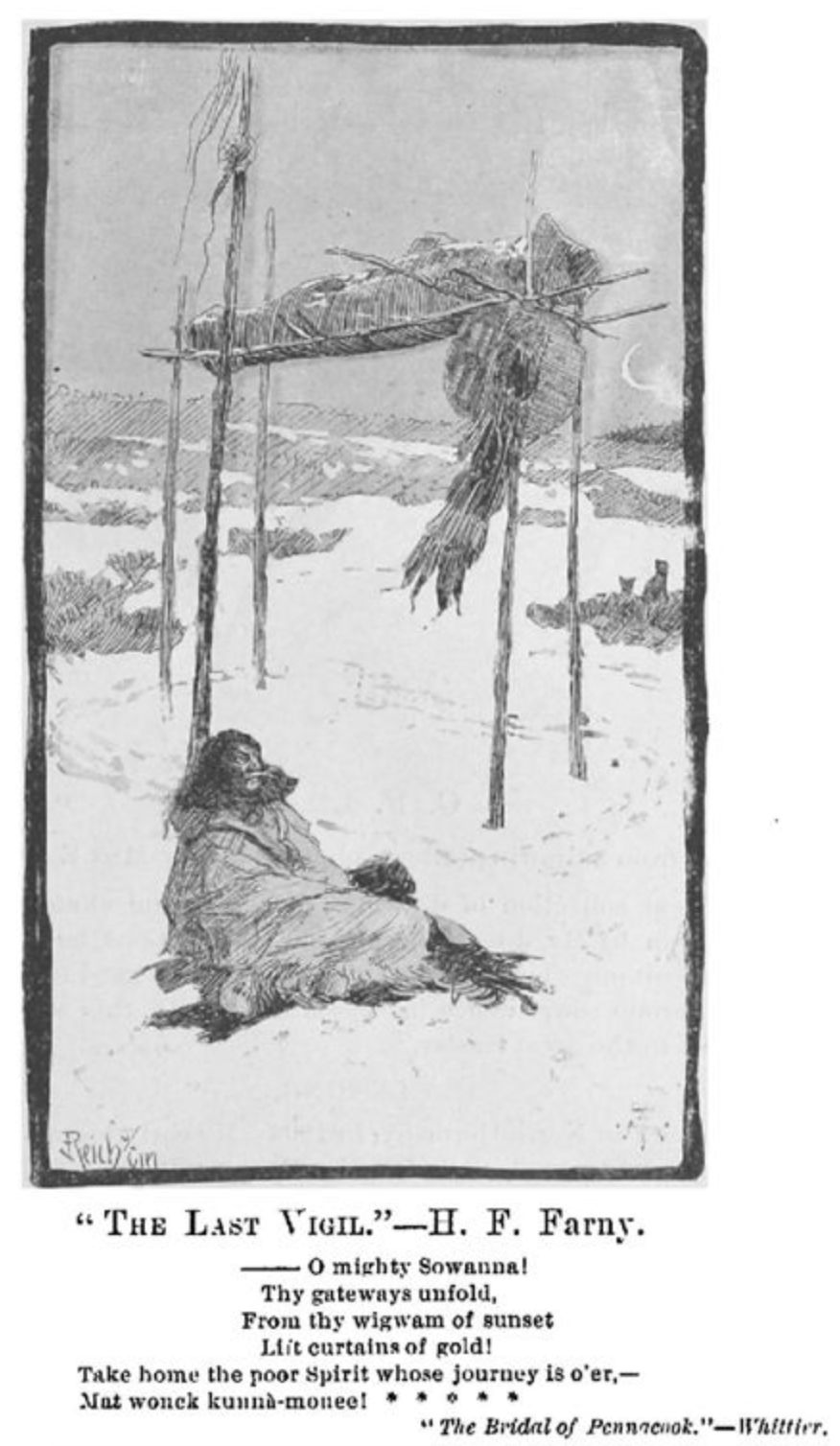
In 1883, Will O Bates chose to comment on Farny’s The Vigil in an article from The Continent about Cincinnati Art, which also included references to Silence. In his commentary, Bates contrasted The Vigil with a later watercolor Farny completed called Sioux Camp at the Medicine Butte, but has not been documented (to my knowledge).
He wrote: H. F. Farny’s “Last Vigil,” painted in 1881, is a picture possessing special interest, not alone on account of its being a striking subject, boldly and unconventionally handled with a deeply-conceived vein of sentiment, but because it was the first product of the artist’s determination to devote himself thence forward to the pictorial perpetuation of the aboriginal life of the Western plains, so rapidly disappearing before the inexorable oncoming of the white settlers.
Mr. Farny, alone of American artists, seems to have taken up the specific task set for himself by the gifted young St. Louis painter, who died in 1863, just when he was beginning to make some use of the invaluable material he had collected by much association with the Indians and study of their character and habits. “The Last Vigil” is rather a prophecy, an aspiration than a finished example of Mr. Farny’s treatment of Indian subjects, as at the time it was painted he had not that familiarity with the life of the plains which subsequent excursions have supplied.
A more intensely dramatic conception than that of the desolate old squaw, watching, amid snow and darkness, at the foot of the scaffold tomb of her husband, might be long sought in vain. There is the mournful destiny and the splendid fortitude of a race in the strong impassiveness of her countenance. The artist owes it to the world to repaint this picture with all the strength which his later experience has brought him. Something of the difference of his later manner may be seen in the spirited water-color, “Sioux Camp at the Medicine Butte.”
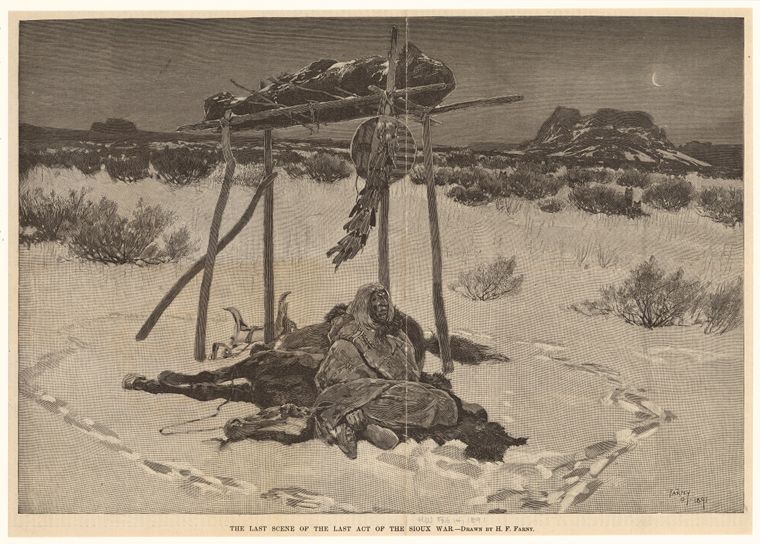
One More Pyre: In 1891, Farny submitted a sketch to the February 14, 1891, edition of Harper’s Weekly. On page 120 is one last funeral pyre by Farny, different enough to be unique from the others. It was titled, The Last Scene of the Last Act of the Sioux War: