In 1882 Farny completed an oil painting titled “After Many Days”. The painting, put on exhibition at Wiswells, is based on a poem by Heinrich Heine, a German poet. There are some translated poems here, but nothing jumped out to me as related to the content of the painting.
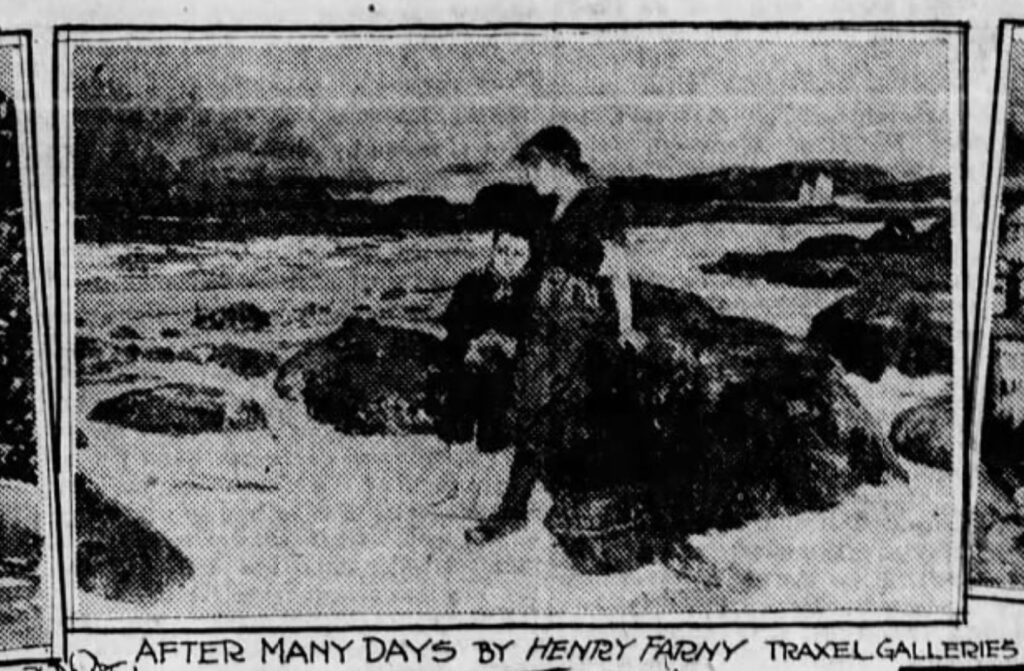
The painting depicts a girl and small boy on a large rock situated on the beach. Farny, according to several news articles of the time, indicated the beach was based on the coast of Normandy.
The Cincinnati News Journal described the painting this way:
Undoubtedly the most striking and original picture in the collection is Mr. Farny’s No. 19, “After Many Days.” Somber and sad as it is, it has a fascination that grows upon one. It is a poem by Heine, with one of Currier’s terrific, tumbling sky backgrounds. You never saw anything like it before, nor will gain. It tells its own story, and is its own reason for being. Look where you will, and your eye comes back to it at last. Mr. Farny is that rare combination, a poet in conception and realist in expression. This picture, painted some months ago, partakes much more of the idealizing, poetical side of the artist than his present work, in which the sentimentality has quite vanished, though the sentiment is still a strong, underlying force.
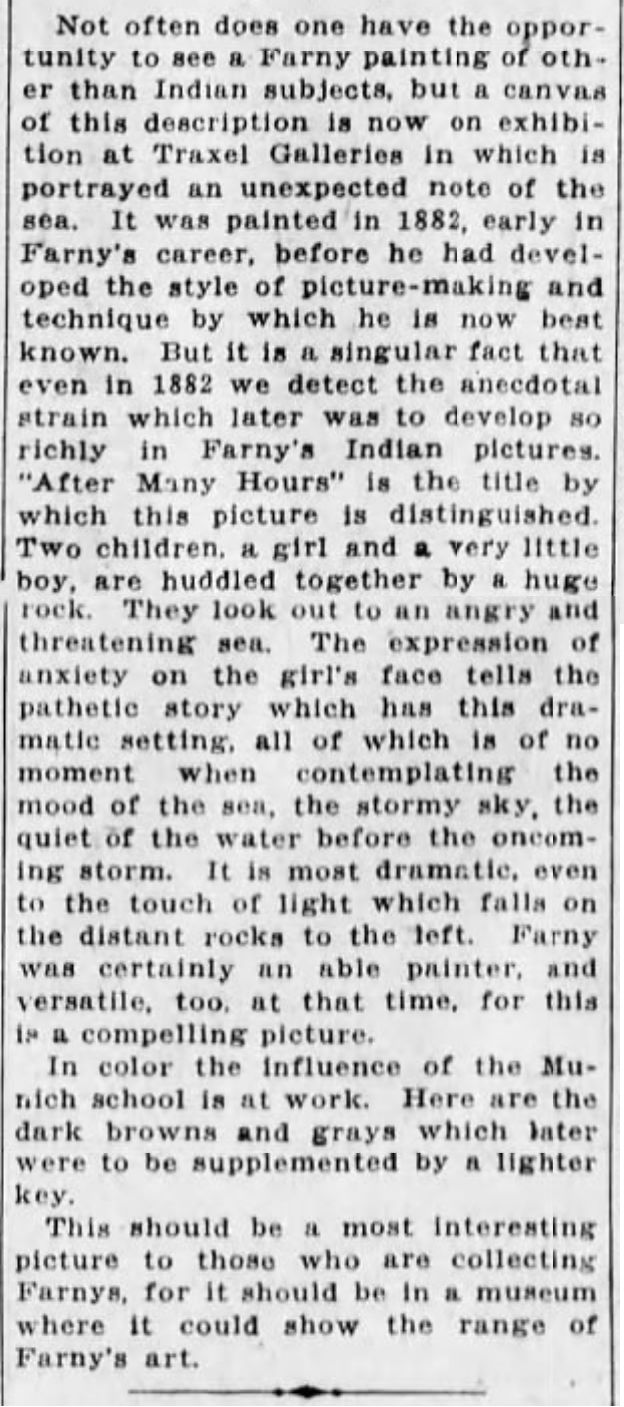
The only image I can find is from a 1928 Cincinnati Enquirer article:
While lauded by critics, Farny struggled to sell it. Finally, in May of 1883, he contributed it to an art auction. Farny had put a price on it of $300, but once the bidding was over, the winning bid was a meager $76. The Cincinnati Commercial Gazette reported after the auction:
Mr. Farny makes an amusing calculation on the actual cost of his picture, “After Many Days” which sold for $76, in which, after allowing for the hire of a model, paints, canvas. a frame that didn’t suit and one that did, he finds he has netted just $9.50 on a picture that cost him two months’ work. He has just sent a distemper drawing to Harper’s Weekly, upon which he was engaged less than two weeks, and for the copyright of which he received $125. “I can’t afford the luxury of painting,” he said, “at least not for this market.”
Farny’s comments underscore why it was important for Farny to keep doing the illustrations. The illustration work supported his painting work. Farny could not see that situation changing in the near future either.
The 1928 article that accompanied the photo of the painting also lauded the work, though it does note mention the Heine reference: